

Blockchain explained simply
Understand the basic idea behind blockchain, the technology that makes cryptocurrencies work.
A shared notebook
Imagine a notebook that records every payment between people in a village. Instead of one person keeping it, every family has an identical copy. When someone pays someone else, the payment is announced, everyone checks it, and everyone writes it in their copy.
If one person tries to cheat by changing their own notebook, the others will see that it does not match. Because many copies exist, the record is very hard to fake.
This is the basic idea of a blockchain.
Blocks and chains
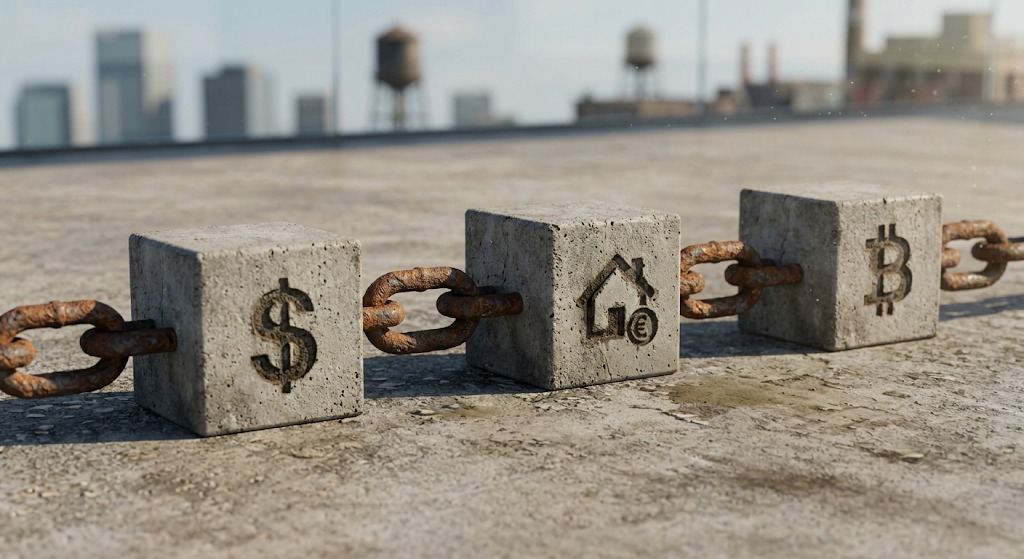
In a blockchain, transactions are grouped into "blocks". Each new block is linked to the one before it using cryptography, a kind of advanced math. This creates a chain of blocks going all the way back to the first one.
If someone tries to change an old transaction, the link between the blocks breaks, and the network rejects the change. This makes the history very hard to rewrite.
Who keeps the records
A blockchain is maintained by many independent computers, called nodes, spread around the world. No single company or government owns the record. To add new blocks, the network needs a way to agree on what is correct.
Proof of work. Used by Bitcoin. Computers compete to solve hard puzzles, and the winner adds the next block and earns new coins. This is called mining, and it uses a lot of electricity.
Proof of stake. Used by Ethereum since 2022. Participants lock up their own coins as a guarantee. They are chosen to confirm blocks and can lose coins if they cheat. It uses far less energy.
Public but not named
On most blockchains, every transaction is visible to anyone. But instead of names, you see long codes called addresses. That is why crypto is described as "pseudonymous" rather than fully anonymous. With enough investigation, transactions can often be traced back to real people.
What blockchain can and cannot do
Blockchain is good at keeping a shared record that is hard to change, without a central authority. People are exploring it for payments, trade documents, digital ownership and more.
But a blockchain only guarantees what is recorded on it. It cannot check whether the information put into it was true in the first place. And the word "blockchain" is often used in advertising to make weak or fake projects sound modern. A project that uses blockchain is not automatically safe or valuable.
Key takeaways
- A blockchain is a shared record kept by many computers.
- Transactions are grouped into blocks linked together in a chain.
- Changing past records is extremely difficult.
- Bitcoin uses proof of work. Ethereum uses proof of stake.
- Transactions are public, but shown with addresses instead of names.
- The word "blockchain" does not make a project trustworthy.
Educational content only, not investment advice. Markets carry risk: only invest money you can afford to lose.